
Quick answer: A memorial service is a gathering to honor someone who has died, held without the body present. It can happen days, weeks or even months after the death, almost anywhere you choose. A funeral usually happens within about a week, with the body present, and the funeral home runs much of it. The biggest difference isn't the casket. It's who makes the decisions. At a funeral, a lot of choices come ready-made. At a memorial service, your family makes nearly all of them.
Nobody tells you this part.
When you plan a funeral, the funeral home handles a lot. A room. A schedule. Someone to lead it. A program template. A standard order of things. The decisions are still hard, but you're choosing from a menu.
When you plan a memorial service, the menu disappears.
You get a date, maybe. And a blank page.
That freedom is a gift. It's also the reason so many families end up at the kitchen table at midnight trying to decide where to hold it, who should speak first, and what goes on the front of the program, all while answering condolence texts. We walked through that exact week in our memorial service planning checklist. This post answers the question that comes before all of it: what a memorial service actually is, how it's different from a funeral, and what that difference means for the decisions your family will be left to make.
What Is a Memorial Service?
A memorial service is a ceremony or gathering held to remember someone after they've died, without the body present. It often follows a cremation or a private burial. It can be religious or not, formal or relaxed, and held in a church, a banquet room, a backyard, or on the dock at the lake.
Because there's no body to prepare and no burial to schedule around, the timing is flexible. Some families gather a week later. Others wait a month or more so relatives can travel, or choose a date that meant something: a birthday, an anniversary, the first warm weekend of the season.
A celebration of life is a style of memorial service with a lighter, more personal tone. If that's the direction you're leaning, we covered it in how to plan a celebration of life that actually feels like you.
Is a Memorial Service the Same as a Funeral?
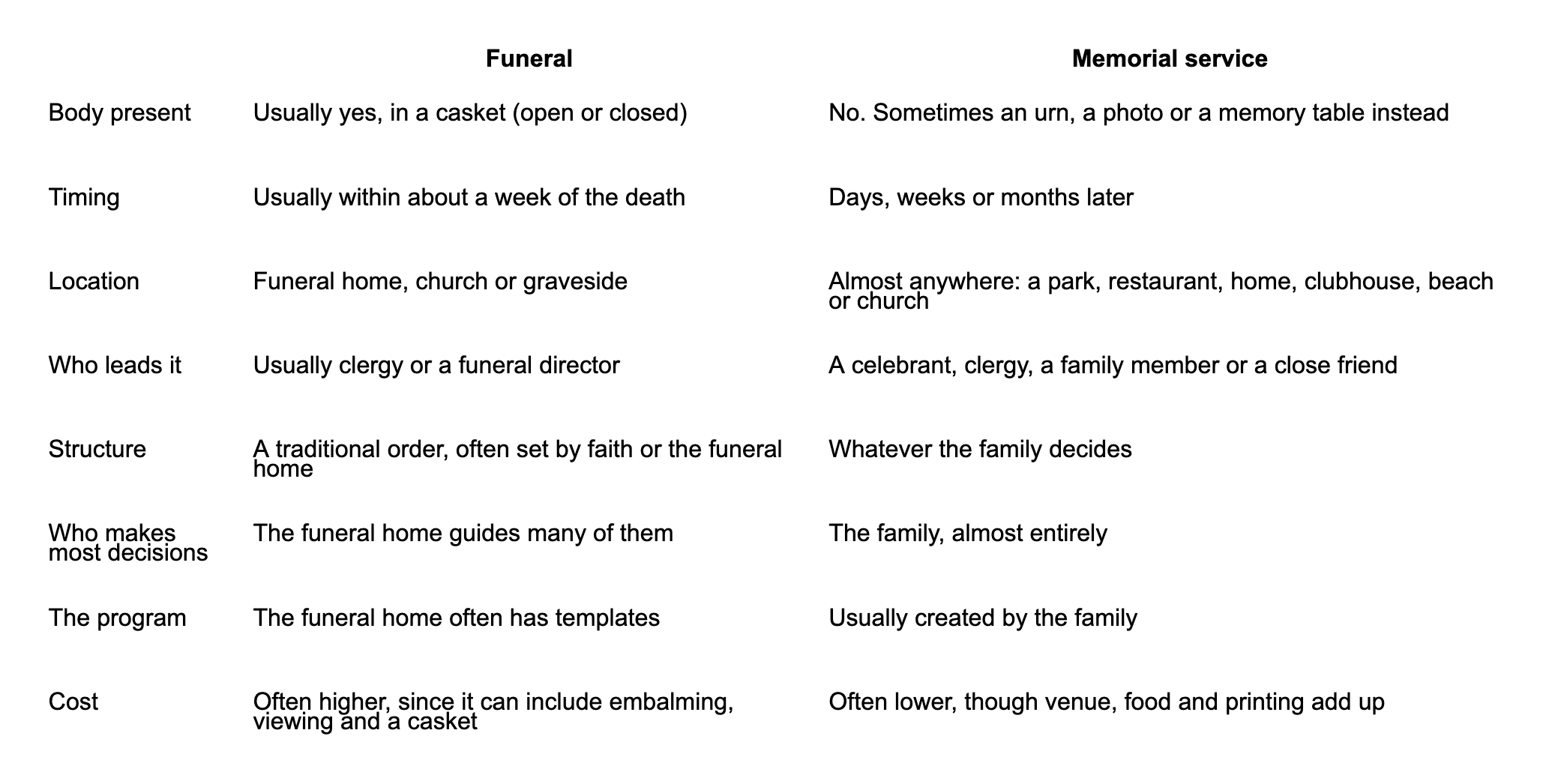
No. Both honor someone who has died, and people use the words interchangeably, but they differ in three practical ways: whether the body is present, how soon it happens, and who runs it.
Memorial Service vs. Funeral at a Glance
You can also do both. Plenty of families hold a small private burial or funeral right away, then a larger memorial service later, when everyone can be there.
And more families are going the memorial route. In the National Funeral Directors Association's 2026 Consumer Awareness and Preferences Study, 62.1% of people said they've attended a service led by someone other than a faith leader. Families are also gathering in banquet halls (30.3%), outdoor settings (18.3%) and at home (10.2%). The tradition is loosening. The planning load is shifting onto families.
The Five Defaults That Disappear
Here's our take after walking a lot of families through this: the real difference between a funeral and a memorial service is what you don't get handed. At a funeral, these five things come mostly pre-decided. At a memorial service, each one becomes a blank.
And blanks don't stay blank. If you don't fill them ahead of time, they get filled by whoever is most tired, fastest, or loudest in the room.
The leader. Someone has to stand up first and hold the room. At a memorial service, nobody is assigned that job unless you assign it. Whoever takes it on needs more than a nudge. They need a written run of show, the names of people to thank, and a cue for when to wrap up.
The script. There's no built-in order of service. You decide what happens first, what happens last, and what people feel in between. Our complete memorial planning guide calls this an "order of experience," and it's worth reading before you write one.
The room. No chapel comes with the package. You pick the place, book it, and figure out the chairs.
The timeline. With no burial to schedule around, the date can slide. "Let's do it in the spring" turns into summer, and then into a gathering that never quite happens. The families who get it right set the date in the first week.
The program. Funeral homes often have templates ready. For a memorial service, someone in the family usually designs and prints it.
None of these is hard on an ordinary Tuesday. All five are brutal in the week after a loss. That's the entire case for deciding them now.
Where to Have a Memorial Service
You can hold a memorial service almost anywhere that fits the person and holds your guest list. Private places mostly need the owner's permission. Public places usually need a permit or reservation. The best location is usually the one where people walk in and immediately think, "Of course. This is so them."
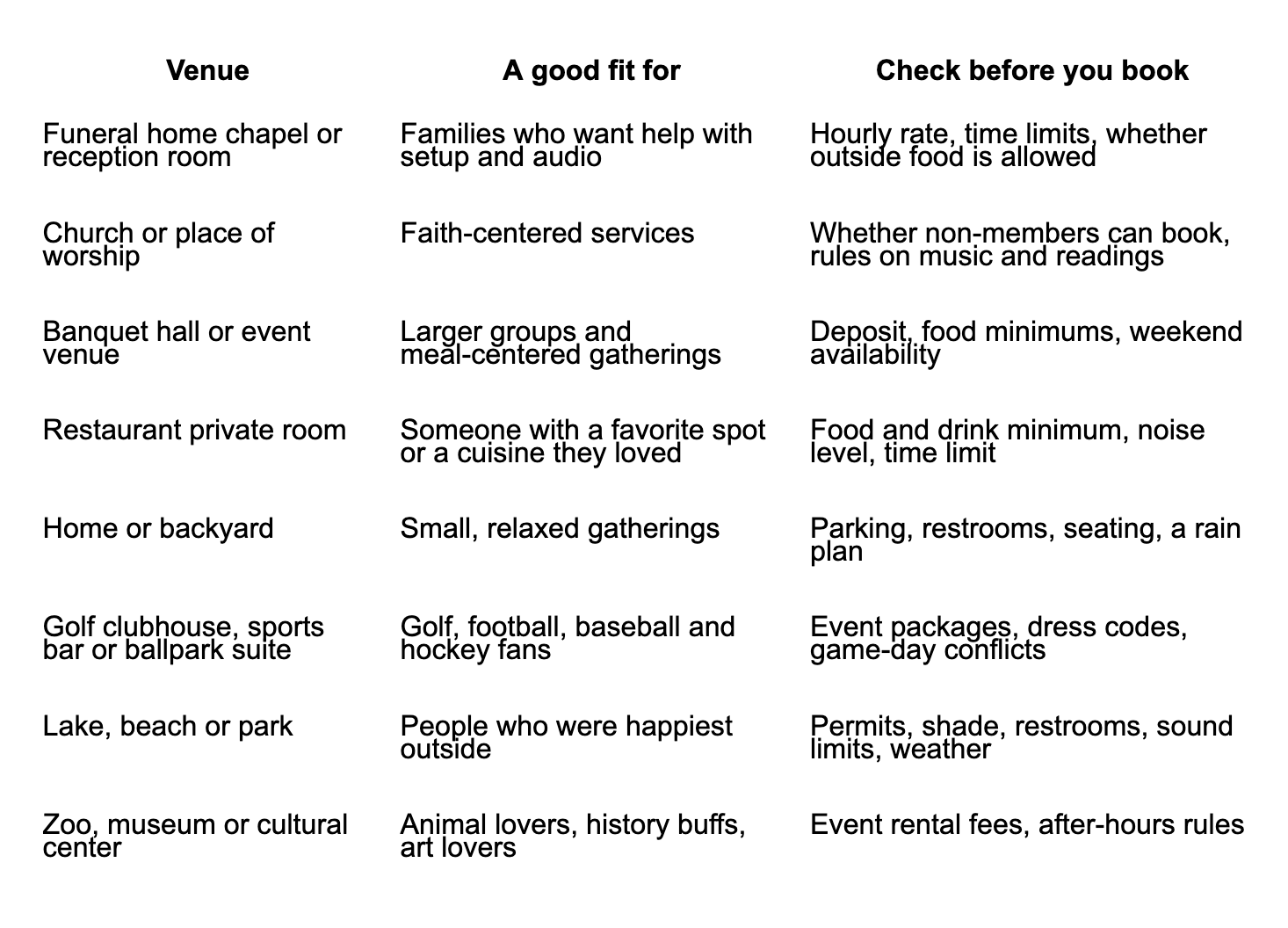
Questions to Ask Any Venue Before You Book
How many people fit, seated and standing?
What's included: tables, chairs, a microphone, a screen for a slideshow?
Can we bring our own food, or do we have to use your caterer?
Can we play our own music, and is there a sound limit?
Is the Wi-Fi strong enough to livestream for family who can't travel?
What's the deposit and cancellation policy, and how long can we stay?
Is there an indoor backup if the weather turns?
Beach, lake and park memorials: the rules to check first
Outdoor memorials can be the most moving of all. They're also where families get surprised, because holding a gathering and scattering ashes are two separate things with separate rules.
The ocean. Under the federal burial at sea rule, cremated remains scattered in the ocean must be released at least three nautical miles from land, and the burial has to be reported to the EPA within 30 days. Flowers and wreaths need to be biodegradable. In practice, that means the gathering often happens on the sand and the scattering happens later from a boat. (EPA)
Lakes and rivers. The federal ocean rule doesn't cover inland water. States set their own rules, and some don't allow it at all. Check with your state's environmental or health agency first.
National parks. Many allow scattering, but usually with a permit or a letter of permission, and the conditions vary park to park. Grand Teton, for example, requires a permit, and Crater Lake doesn't allow releasing birds, butterflies or other objects during a scattering. Apply weeks ahead, not days.
City, county and state parks or public beaches. A group gathering may need a special event permit or a pavilion reservation, and the popular spots on weekends can book up fast. Call the parks department before you send a single invitation.
Rules change and they differ by location, so always confirm with the agency that manages the place you have in mind. This is also exactly why an outdoor memorial is so hard to pull together in a week, and so easy to plan in advance.
Our Beach, Lake, Fishing and Hunting guides each include location ideas built for that theme, so you're not starting the search from zero.
What Goes in a Memorial Service Program
A memorial service program, sometimes called an order of service, is the printed or digital handout guests receive when they arrive. It tells people what's happening, introduces the speakers, and gives everyone something with the person's face on it to take home. The most common format is a single letter-size sheet folded in half.
Here's a simple layout that works for almost any memorial service:
Front cover: Their full name (and the nickname everyone actually used), birth and death dates, a favorite photo, and one line that sounds like them. A saying they repeated. A sign-off they always used.
Inside left: The order of service, with names. Welcome, music, readings, tributes, open sharing, closing.
Inside right: A short life story, about 150 to 250 words. Where they grew up, who they loved, what they couldn't stop talking about.
Back cover: A thank-you from the family, reception details, any "in lieu of flowers" request, and a QR code that links to a shared photo album, digital guestbook or livestream recording.
A few things that save headaches:
Have two people proofread every name. Misspelled names are the mistake families remember.
Print a few days early and order more than your headcount.
Be careful with lyrics and poems. Printing the full lyrics of a modern song or the full text of a recent poem can raise copyright issues. Listing the title is always fine. Older works in the public domain, or words written by the family, are safe choices.
One more thing we've noticed: the program usually gets left on a chair. The recipe card keepsake goes home and gets used. Plan both.
Memorial Service Ideas by Theme
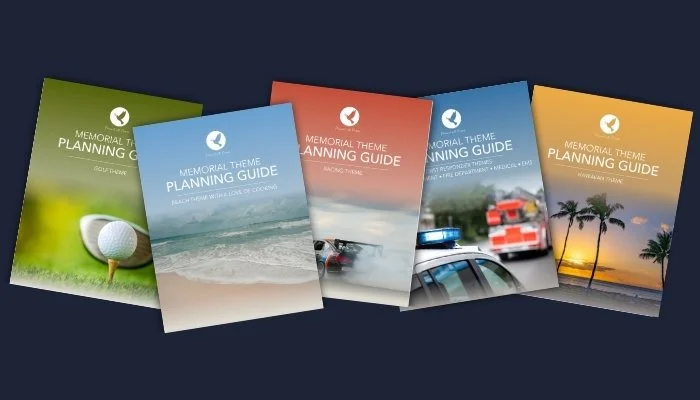
Once you know the place and the program, a theme ties them together. If you're not sure which one fits, our post on how to choose a memorial theme that feels like them walks you through it. Here's how a theme can shape the three decisions in this post:
Golf: Gather on the clubhouse patio. Print the order of service like a scorecard, with "Hole 1: Welcome." Hand out the recipe for their go-to 19th-hole snack. (Golf guide)
Italian, Greek or German: Book a private room for a family-style meal. Put a toast in the family's language on the program. Make the recipe card the Sunday sauce. (Italian, Greek, German)
New Orleans: End with a second line out the door. Print the playlist on the program so people can find the songs later. Gumbo on the recipe card. (New Orleans guide)
Military or first responder: Ask the funeral home about military funeral honors (you'll need the DD-214, which we covered in what to expect when the funeral home calls). Add a short service history to the program. (Military, First Responder)
British tea time: Afternoon tea in a garden. A small program tucked beside each saucer. Their scone recipe, with the "don't overmix" note in the margin. (British Tea Time guide)
Football or baseball: A tailgate-style gathering. The order of service printed as a lineup card. Their chili recipe, obviously. (Football, Baseball)
Most people are more than one theme, and that's fine. Mixing two guides often gets closer to the real person than one ever could.
Fill the Blanks Now, Not the Week Of
The flexibility of a memorial service is a trap if you wait for it. "There's no rush" is exactly how a family ends up making every one of these decisions in the same exhausting week.
Here's a 20-minute exercise you can do tonight, for yourself or with someone you love:
Who should lead it?
Where would it feel most like them?
What time of year would they want?
Which three songs, by name?
Which recipe goes on the card?
Write down the answers. That's the hardest part of planning a memorial service, done. If you want to keep going, we wrote about why planning a memorial before you need one changes everything, and how to plan a memorial without feeling overwhelmed if this already feels like a lot.
Then let a Themed Memorial Planning Guide fill in the rest of the blank page. Each one is an instant digital download with:
A multi-page memorial planning guide PDF that walks through decisions in order
Invitation ideas
Memorial location ideas that fit the theme
Music playlist suggestions
Tribute and remembrance ideas
Guest favor inspiration
An editable, two-sided Canva recipe card keepsake for a favorite recipe on one side and a photo and memory on the other
There are 24 themes, from Beach and Lake to Golf, Italian, New Orleans, Zoo and Derby Day. Most guides are $9.99. The Military and First Responder guides are $16.99.
Every blank you leave gets filled by someone guessing. Fill them now, while it's still a conversation and not an emergency.
Pick Your Theme & Download Now
Frequently Asked Questions
What is a memorial service? A memorial service is a gathering to remember and honor someone who has died, held without the body present. It often follows cremation or a private burial and can take place days, weeks or months after the death, in almost any location.
Is a memorial service the same as a funeral? No. A funeral usually happens within about a week of the death with the body present and is often led by clergy or a funeral director. A memorial service happens without the body, on a more flexible timeline, and is usually planned and led by the family.
What's the difference between a memorial service and a celebration of life? A celebration of life is a type of memorial service. It tends to be lighter and more personal, built around the person's personality, hobbies and favorite things instead of a traditional format.
Can you have both a funeral and a memorial service? Yes. Many families hold a private funeral or burial soon after the death and a larger memorial service later, when more people can travel.
Where can you have a memorial service? Almost anywhere that fits the person and your guest list: a funeral home, church, banquet hall, restaurant, home, park, golf clubhouse, lake or beach. Public places often need a permit, and scattering ashes has its own rules depending on the location.
What goes in a memorial service program? Most programs include the person's name, dates and photo on the front, the order of service and speakers inside, a short life story, and a thank-you and reception details on the back. Many families add a QR code for a photo album or digital guestbook.
Who leads a memorial service? Anyone the family chooses: clergy, a certified celebrant, a funeral director, a family member or a close friend. Whoever it is should have a written order of service and a list of people to thank.
Do I need a funeral home for a memorial service? Not always for the gathering itself. You'll typically still work with a funeral home or crematory for the cremation or burial and the death certificate, and rules vary by state. Under the FTC Funeral Rule, you can choose only the goods and services you want.
Keep Reading: The Memorial Planning Series
How do I start planning a memorial service? Find your starting point.
The memorial service planning checklist A week-by-week plan.
What to expect when the funeral home calls The documents they'll ask for first.
How to plan a memorial without feeling overwhelmed Keeping it manageable.
The 48 hours nobody warns you about Planning before you need to.
How to choose a memorial theme that feels like them Five questions that find the theme.
How to plan a personalized memorial The details that make it personal.
How to plan a celebration of life that feels like you Designing your own.
The recipe card memorial keepsake The keepsake guests keep.
Memorial planning made simple: a complete guide The full framework.
Sources
National Funeral Directors Association, 2026 Consumer Awareness and Preferences Study release (June 2, 2026)
U.S. Environmental Protection Agency, Burial at Sea
National Park Service, Grand Teton scattering of ashes permit
National Park Service, Crater Lake scattering of ashes permit information
Federal Trade Commission, The Funeral Rule
Disclaimer: The information, services, and products provided on this blog post, including the custom funeral planning binder, digital download products, blog posts, tips, resources, and other related materials, are offered for informational and organizational purposes only. While we strive for accuracy and aim to help customers plan and organize their end-of-life arrangements, we do not provide legal, financial, or medical advice. The content and products on this site, including all informational resources, are not a substitute for professional services from attorneys, financial advisors, or healthcare providers. We do not guarantee the completeness, legality, or applicability of our products or information in all jurisdictions, and we are not liable for any damages or consequences arising from their use. Users are encouraged to consult with appropriate professionals for specific legal or financial advice regarding their individual situations. By using this website, you acknowledge and agree to our Privacy Policy and Terms and Conditions, and you accept that the use of our products, services, and informational resources is at your own risk.